
 IT
ITPantalica what to see: trekking and history in Sicily’s UNESCO necropolis
Category/ies: Surroundings
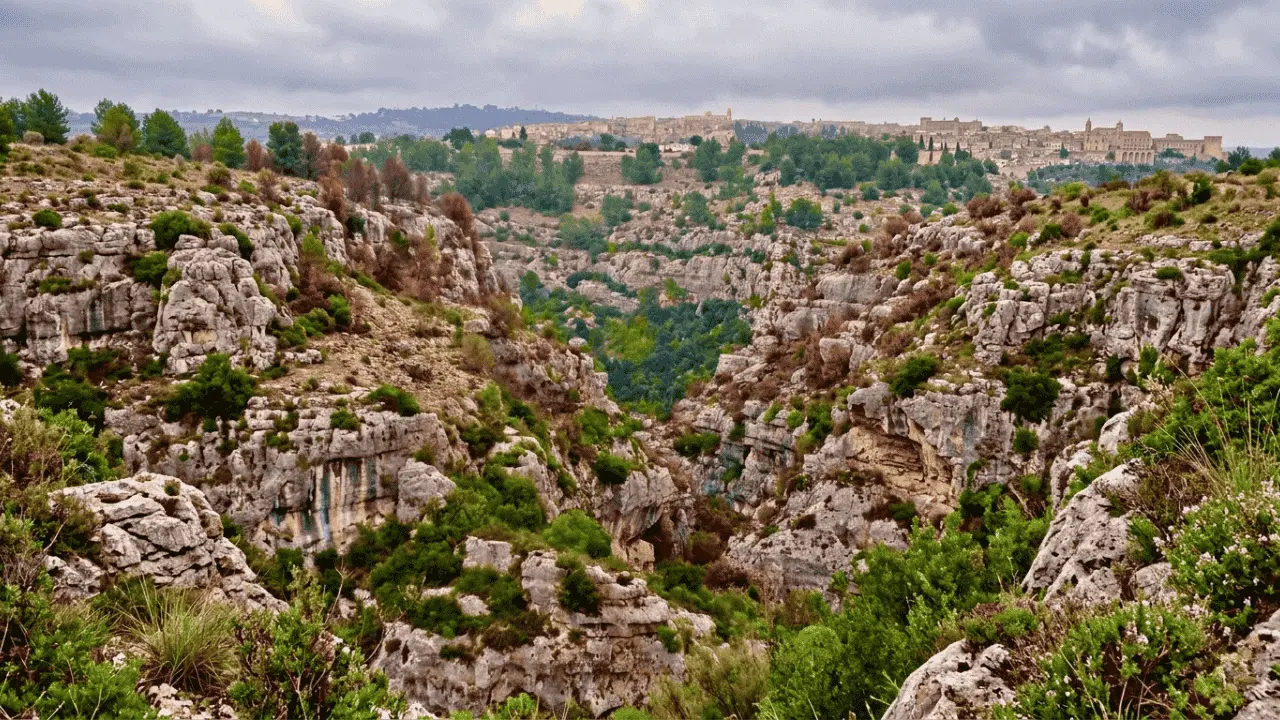
There are places that can’t be explained: they must be walked. Pantalica is one of them. Just a few kilometers from Olive Alive, hidden among the gorges carved by the Anapo and Calcinara rivers, lies one of the largest and most extraordinary rock necropolises in Europe: a landscape that takes your breath away not for what was built, but for what remains.
A prehistoric beehive in the rock
Pantalica is home to over 5,000 tombs carved into the rock, dating back to the Bronze Age between the 13th and 7th centuries BC. The tombs, spread along the sheer walls of the valley, create a surreal spectacle, almost lunar, and bear witness to one of the island’s most important protohistoric communities.
The name itself derives from the ancient Greek pantalithos, which means “all stone, place of stones.” A name that says it all. Since 2005, along with the city of Syracuse, Pantalica has been a UNESCO World Heritage site.
What to see in Pantalica
The site is vast and layered: prehistoric archaeology, medieval history, and untouched nature coexist along the same paths.
On the highest point of the plateau, you’ll find the remains of the Anaktoron, the so-called Prince’s Palace, the only stone building in the settlement. The most interesting necropolis is San Martino, featuring prehistoric tholos tombs and Byzantine catacombs like the Grotto of Saint Anne and the Hypogeum of Dionysius, complete with frescoes and inscriptions.
There is no shortage of evidence from the Byzantine era: three rock oratories with traces of ancient frescoes — San Micidiario, San Nicolicchio, and the Oratory of the Crucifix — tell the story of communities that sought refuge in these inaccessible canyons during the centuries of invasions.
Inside the San Nicolicchio oratory, several paintings on overlapping layers are still recognizable: a headless figure in a white tunic, a depiction of Saint Stephen, and one of Saint Helena—the only Byzantine frescoes in all of Pantalica, dating back to the 8th-9th century.
The Pantalica necropolises in brief
To orient yourself before setting off, here are the main points of the site:
- North Necropolis and Cavetta Necropolis: the areas with the highest concentration of chamber tombs, clearly visible on the valley walls.
- San Martino Necropolis: prehistoric tholos tombs and Byzantine catacombs, including the Grotto of Saint Anne and the Hypogeum of Dionysius.
- Anaktoron (Prince’s Palace): the remains of the only stone building, on the highest point of the plateau.
- Byzantine rock oratories: San Micidiario, San Nicolicchio, and the Oratory of the Crucifix.
The trails: from history to nature
The necropolis is accessible from several entrances, mainly from Ferla and Sortino, with well-marked trails that allow you to explore the different areas of the site. The routes range from 5 to 13 km in length.
One of the most evocative follows the path of the old railway: starting from the Anapo Valley entrance, you walk for about 13 km on an almost completely flat path, passing through tunnels carved into the rock and enjoying spectacular views of the Anapo River, where you can take a refreshing dip during the warmer seasons.
The entrance from the Sortino side offers the most striking view of the North Necropolis, with a shorter but steeper trail that leads to the clear waters of the Calcinara stream for a rejuvenating break.
Which trail to choose
| Trail | Entrance | Features | Suitable for |
|---|---|---|---|
| Former railway (about 13 km) | Anapo Valley | Almost flat, tunnels carved in the rock, views of the Anapo river | Those seeking a long but easy walk |
| North Necropolis and Calcinara | Sortino | Shorter, with greater elevation gain, reaches the waters of the Calcinara stream | Those wanting the best view of the tombs and a swim |
| Short trails (from about 5 km) | Ferla / Sortino | Shorter itineraries among the archaeological areas | Families and those with limited time |
The trails are marked, but they are proper hikes: you need a minimum level of fitness for the longer trails and those with elevation gain.
Italo’s advice
“Pantalica is one of those places you don’t expect. You go in thinking you’ll see an archaeological site and find yourself inside a canyon, with the sound of the river, the birds, and the living rock. I recommend the Ferla entrance, which is closer to the Tenuta: plan for at least half a day, bring water and something to eat. And if you can, bring your swimsuit: the waters of the Anapo in summer are a well-deserved reward.”
How to organize your visit
The walk in Pantalica is free. The hiking trails are well-maintained and signposted. The best seasons are spring and autumn; in summer, it’s better to set off in the early morning hours to avoid the heat on the more exposed sections. From Tenuta Olive Alive, the Ferla entrance is the most convenient, reachable in about 40 minutes. For those who want a refreshing swim, the ideal spot is the Calcinara stream, accessible from the Sortino entrance.
How to get to Pantalica
Pantalica is located between Ferla and Sortino, in the Syracuse area. The most practical way to get there is by car, as there are no direct public transport connections.
- From Tenuta Olive Alive and from Noto: about 40 minutes to the Ferla entrance.
- From Syracuse: about an hour by car. From the SS 124 continue toward Floridia and Solarino, then Cassaro and finally Ferla.
- Ferla entrance: from the town follow the signs for Pantalica along Regional Road 11 to the parking area.
- Sortino entrance: follow the scenic road “via Pantalica” to the Reserve gate.
The two entrances are separated by the Calcinara valley: going from one to the other by car requires a long detour, even 45–60 minutes. It’s best to choose the entrance based on your trail and not switch midway through the day.
Parking, hours, and costs
- Entrance: free, no reservation required.
- Hours: the Reserve entrances are accessible from morning until sunset. The gate is closed in the evening, so don’t get caught in the dark and return to your car while it’s still light.
- Parking: available near both entrances, close to the trails.
- Services: along the access road from Ferla there is a Reserve information point with maps and restrooms. There are no bars or shops inside the area, so bring everything with you.
What to bring
- Hiking boots or closed shoes with good soles
- Plenty of water (at least 1.5–2 liters per person in summer) and something to eat
- Hat, sunscreen, and sun protection in exposed sections
- Swimsuit and towel for a dip in the Anapo or Calcinara
- A flashlight or headlamp, useful in the former railway tunnels
- A bag for your trash: there are no bins in the Reserve
How much time you need
For a leisurely visit, plan for at least half a day. The short trails take two or three hours; the former railway, round trip with stops, can take a full day. If you want to combine archaeology and a swim in the Calcinara, set off early in the morning.
Can you visit Pantalica for free?
Yes, access to the Reserve and the trails is free.
Which is the best entrance?
From Tenuta Olive Alive we recommend the Ferla entrance, which is closer. The Sortino entrance is ideal for the view of the North Necropolis and for reaching the Calcinara stream.
Can you swim?
Yes, in the Anapo and Calcinara during the warmer months, where the water is sufficient and the riverbed allows. Always assess the conditions at the time.
When should you go?
In spring and autumn, for the mild climate. In summer, setting off in the early morning hours.
Can you cycle along the former railway?
The route can also be cycled; to access it by bike you need to check the Reserve rules and, if required, obtain authorization from the managing authority.
What to see nearby
If you have more days, combine Pantalica with other stops in the Val di Noto, a short distance from the Tenuta:
- Noto Antica: the ruins of the lost city.
- Vendicari Nature Reserve: sea, salt pans, and coastal trails (insert link to the article on the reserve here).
- The Baroque center of Noto and the city of Syracuse, with Ortigia.
Your home in the Val di Noto
After a day among prehistoric tombs, canyons, and trails, the best way to finish is to return to a place where you can rest. Tenuta Olive Alive is about 40 minutes from Pantalica, among the olive trees: you can relax in the SPA, dine on farm produce at the Home Restaurant, and sleep in our Suites & Cottage.



Tenuta Olive Alive is not just a hotel: it’s a countryside to be discovered
Among ancient olive trees, poetry paths and quiet viewpoints over Noto: discover Tenuta Olive Alive. Take your time.
Itineraries: The Vendicari Nature Reserve in Sicily
Itineraries: The Vendicari Nature Reserve. History, Wildlife, and Recommended Routes

Charity Dinner at Tenuta Olive Alive
Charity Dinner with Live Music at Tenuta Olive Alive

Marie Claire France features Tenuta Olive Alive: the authentic Sicily
Marie Claire France dedicated an article to Tenuta Olive Alive, the charming estate 5 minutes from Noto: calm, personal hospitality,…
Noto Antica what to see: guide to the ruins of the lost city
Noto Antica what to see: the Royal Castle, the Piazza Maggiore, the Norman walls. A guide to the “Sicilian Pompeii”,…

Infiorata di Noto 2026: Dates, Theme and Program – Pop Culture in Bloom
Infiorata di Noto 2026 returns from May 15 to 19: 700 square meters of flowers will transform Via Nicolaci in…